Excimer lampsare ultraviolet lamps that are designed to emit UV wavelengths in the range of approximately 170 nanometers (nm) to 230 nm, dependent upon noble gas excimers present. Excimer lamps are useful in many applications, such as UVC disinfection, ozone generation, and UV curing processes.
What is an Excimer Lamp?
Excimer is a term that refers to a temporary atomic state where high-energy atoms create short-lived molecular pairs, or dimers, when electronically excited.
Excimer refers to a transient atomic state in which electronically excited high-energy atoms create short-lived molecular partners or dimers. UVC photons are released as excited dimers, excimers, return to their original state. The term excimer refers specifically to homodimeric bonds, a bond between the same species of molecules such as xenon (Xe). A xenon excimer lamp uses Xe atoms to form excited Xe2 dimers, which result in UV photons emitted at the 172 nm wavelength.
Heterodimeric bonds (bonds from two different structural species), has the official term of an exciplex. An example of an exciplex is the bond with Krypton-chloride (KrCl), which is an exciplex that emits wavelengths in the range of 222 nm.222 nm UV lightis recognized for high antimicrobial capabilities and is also referred to as Far UVC.
Excimer lamps are the generally accepted term for lamps that emit both excimer and exciplex radiation in the range of 172 nm and 222 nm, respectively.
How Do Excimer Lamps Work?
Excimer lamps irradiate the desired UV wavelength in the vacuum ultraviolet (VUV) range (between 100 – 200 nm) in a specialty coated, sealed quartz glass chamber with noble gases. An intense plasma discharge also called a dielectric barrier discharge, is generated from the high-energy electrons. The atomic excitement of noble gases is induced by the plasma, which triggers the creation of excited dimers, or excimers. The Excimer-specific UV radiation results during the final emission stage when Excimer molecules disassociate and return to their original state, all of this occurring in nanoseconds.
Excimer Lamp Application Uses
Excimer lamps are ideal in many applications and are gaining significant attention with the ability to disinfect surfaces with the same efficacy as traditional 254 nm UV lamps with less human exposure risks when used with an appropriate optical filter.
Excimer Lamps for Disinfection, 222 nm
Excimer lamps designed to emit 222 nm radiation, also calledFar UVC lamps, are increasing in use for disinfection applications worldwide with the same germicidal effectiveness as traditional 254 nm lamps and can be used in the presence of humans with less risk when used in conjunction with an appropriate optical filter. In onestudypublished at the National Library of Medicine, the effects of 222 nm UVC light for disinfection were shown to be effective on methicillin-resistant Staphylococcus aureus infection in mouse wounds without damaging DNA.
Both222 nm lampsand 254 conventional low-pressure mercury lamps were used in this study. 222 nm UVC light significantly reduced bacterial count on mice skin wounds infected with methicillin-resistant Staphylococcus aureus (MRSA). When compared with the effectiveness on days 3, 5, 8, and 12, irradiation of bacterial counts with 222 nm UV light was the same as or even more effective than 254 nm radiation.
Disinfection and Safety
While 254 nmUVC germicidal lampshave been used for decades and are highly effective at eliminating the risk of infection from many viruses, bacteria, and harmful pathogens, exposure to this wavelength is harmful to humans.
Short wave, 222 nm UV light, is absorbed by the proteins in the membrane and, therefore, does not reach the nucleus of human cells. This samestudyevaluated the safety of 222 nm excimer lamps vs 254 nm conventional germicidal lamps and found that immediately after irradiation, the epidermis irradiated with 254 nm light showed the presence of CPD expressing cells but was not present after irradiation with 222 nm UVC. Excimer lamps emitting 222 nm light are proving to provide highly effective disinfection combined with human biological safety.
Excimer lamps have other uses in addition to disinfection, and not all Excimer lamps are farUVC lamps.
Excimer Lamps for Surface Activation, 172 nm
Alteration of surface energy is required in many industrial applications for surface treatments, such as applying coatings and adhesives to substrates. 172 nm lamps are an excellent choice for surface modification and provide additional benefits of cleaning and activating substrate surfaces simultaneously. 172 nm provides powerful electromagnetic energy to directly crack major bonds in organic molecules without altering any physical surface properties.
Excimer lamps designed to emit 172 nm increase the wettability and surface energy of various substrates such as glass, metals, and polymers. Surface energy is measured in millinewtons per metre (mN/m), with 172 nm excimer lamps meeting surface activation energy requirements for solvent inks, UV inks, water-based systems, and coatings. Excimer lamp technology provides many benefits to UV curing applications, including cleaning, bonding, and coating.
Surface Activation Alternative Treatment
172 nm Excimer lamps are a good alternative to plasma and Corona-based surface treatments with considerably less excess heat and reduced thermal load. Both plasma and Corona are electrical discharge surface activation methods. Excimer lampsprovide effective surface activation without damage to surface structure, resulting in better results for bonding.
Ozone Production with Excimer Lamps, 172 Nm
Excimer lamps are also effective at producing ozone, a natural oxidizer, odor reducer, and disinfectant effective in air and water disinfection applications. Ozone is typically produced at 172 nm standard low-pressure mercury lamps, although Excimer lamps filled with xenon are an efficient source to generate ozone with no nitrogen oxides (NOx) as the UV radiation is not high enough to excite nitrogen in the air.
Excimer lamps are proving to be a very exciting development and an increasingly promising offering in the UV lamp market.
LightSources is currently in the development of Excimer lamps, and we offer a wide selection ofUVC germicidal lampsused in surface, water, and air disinfection systems worldwide. We design, engineer, and manufacture UVC germicidal lamps, UV curing lamps for surface treatment applications, as well as ozone-producing lamps.
LightSources is a leading global supplier of high-quality UV lamps proven in a wide range of applications. Our high-tech UV lighting engineers offer custom phosphor blends, lamp design, and prototype development to meet specific wavelength requirements. Contact us to learn more about the many benefits of Excimer lamps.
When Christian L. Sauska and his former business partners established LightSources, Inc. in 1983, they envisioned a company that would offer global OEM lamp designs and manufacturing, supported by state-of-the-art technology and exceptional service and support. This vision lives today through the dedication of approximately 1,000 employees worldwide.
Today, LightSources and its affiliated companies – LCD Lighting, Voltarc along with strategic partners LightTech, and Cerlux – are regarded as innovative, high-tech, designers, light bulb manufacturers and light bulb suppliers in the lamp manufacturing industry. Our products are used worldwide across a multitude of applications and industries. We are especially proud to have our avionic display backlighting in Transportation, National Defense, and the US Space Program.
Our team, which includes experienced professionals in the production of low-pressure tanning lamps, specialty UVC germicidal lamps, custom light bulbs, and UV lamps for other specialized applications such as air purification and ballast water treatment, is committed to engineering standard, specialty, and proprietary lamp types to meet the specific requirements of our clients. From prototype to finished product, we offer unmatched flexibility and turnaround. With our innovative solutions, clients can distinguish themselves in the marketplace with their own proprietary products and private brands.
When Christian L. Sauska and his former business partners established LightSources, Inc. in 1983, they envisioned a company that would offer global OEM lamp designs and manufacturing, supported by state-of-the-art technology and exceptional service and support. This vision lives today through the dedication of approximately 1,000 employees worldwide.
Today, LightSources and its affiliated companies – LCD Lighting, Voltarc along with strategic partners LightTech, and Cerlux – are regarded as innovative, high-tech, designers, light bulb manufacturers and light bulb suppliers in the lamp manufacturing industry. Our products are used worldwide across a multitude of applications and industries. We are especially proud to have our avionic display backlighting in Transportation, National Defense, and the US Space Program.
Our team, which includes experienced professionals in the production of low-pressure tanning lamps, specialty UVC germicidal lamps, custom light bulbs, and UV lamps for other specialized applications such as air purification and ballast water treatment, is committed to engineering standard, specialty, and proprietary lamp types to meet the specific requirements of our clients. From prototype to finished product, we offer unmatched flexibility and turnaround. With our innovative solutions, clients can distinguish themselves in the marketplace with their own proprietary products and private brands.
By continuing to use this site, you accept our use of cookies and other online technology to send you targeted advertisements, for social media, for data analytics and to better understand your use of our website.
This website uses cookies to improve your experience while you navigate through the website. Out of these, the cookies that are categorized as necessary are stored on your browser as they are essential for the working of basic functionalities of the website. We also use third-party cookies that help us analyze and understand how you use this website. These cookies will be stored in your browser only with your consent. You also have the option to opt-out of these cookies. But opting out of some of these cookies may affect your browsing experience.
Necessary cookies are absolutely essential for the website to function properly. This category only includes cookies that ensures basic functionalities and security features of the website. These cookies do not store any personal information.
Any cookies that may not be particularly necessary for the website to function and is used specifically to collect user personal data via analytics, ads, other embedded contents are termed as non-necessary cookies. It is mandatory to procure user consent prior to running these cookies on your website.
Excimer Lamps: Many Uses Beyond Far UVC
Excimer lamps are ultraviolet lamps that are designed to emit UV wavelengths in the range of approximately 170 nanometers (nm) to 230 nm, dependent upon noble gas excimers present. Excimer lamps are useful in many applications, such as UVC disinfection, ozone generation, and UV curing processes.
What is an Excimer Lamp?
Excimer is a term that refers to a temporary atomic state where high-energy atoms create short-lived molecular pairs, or dimers, when electronically excited.
Excimer refers to a transient atomic state in which electronically excited high-energy atoms create short-lived molecular partners or dimers. UVC photons are released as excited dimers, excimers, return to their original state. The term excimer refers specifically to homodimeric bonds, a bond between the same species of molecules such as xenon (Xe). A xenon excimer lamp uses Xe atoms to form excited Xe2 dimers, which result in UV photons emitted at the 172 nm wavelength.
Heterodimeric bonds (bonds from two different structural species), has the official term of an exciplex. An example of an exciplex is the bond with Krypton-chloride (KrCl), which is an exciplex that emits wavelengths in the range of 222 nm. 222 nm UV light is recognized for high antimicrobial capabilities and is also referred to as Far UVC.
Excimer lamps are the generally accepted term for lamps that emit both excimer and exciplex radiation in the range of 172 nm and 222 nm, respectively.
How Do Excimer Lamps Work?
Excimer lamps irradiate the desired UV wavelength in the vacuum ultraviolet (VUV) range (between 100 – 200 nm) in a specialty coated, sealed quartz glass chamber with noble gases. An intense plasma discharge also called a dielectric barrier discharge, is generated from the high-energy electrons. The atomic excitement of noble gases is induced by the plasma, which triggers the creation of excited dimers, or excimers. The Excimer-specific UV radiation results during the final emission stage when Excimer molecules disassociate and return to their original state, all of this occurring in nanoseconds.
Excimer Lamp Application Uses
Excimer lamps are ideal in many applications and are gaining significant attention with the ability to disinfect surfaces with the same efficacy as traditional 254 nm UV lamps with less human exposure risks when used with an appropriate optical filter.
Excimer Lamps for Disinfection, 222 nm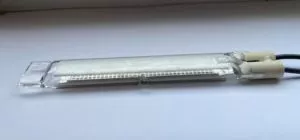
Excimer lamps designed to emit 222 nm radiation, also called Far UVC lamps , are increasing in use for disinfection applications worldwide with the same germicidal effectiveness as traditional 254 nm lamps and can be used in the presence of humans with less risk when used in conjunction with an appropriate optical filter. In one study published at the National Library of Medicine, the effects of 222 nm UVC light for disinfection were shown to be effective on methicillin-resistant Staphylococcus aureus infection in mouse wounds without damaging DNA.
Both 222 nm lamps and 254 conventional low-pressure mercury lamps were used in this study. 222 nm UVC light significantly reduced bacterial count on mice skin wounds infected with methicillin-resistant Staphylococcus aureus (MRSA). When compared with the effectiveness on days 3, 5, 8, and 12, irradiation of bacterial counts with 222 nm UV light was the same as or even more effective than 254 nm radiation.
Disinfection and Safety
While 254 nm UVC germicidal lamps have been used for decades and are highly effective at eliminating the risk of infection from many viruses, bacteria, and harmful pathogens, exposure to this wavelength is harmful to humans.
Short wave, 222 nm UV light, is absorbed by the proteins in the membrane and, therefore, does not reach the nucleus of human cells. This same study evaluated the safety of 222 nm excimer lamps vs 254 nm conventional germicidal lamps and found that immediately after irradiation, the epidermis irradiated with 254 nm light showed the presence of CPD expressing cells but was not present after irradiation with 222 nm UVC. Excimer lamps emitting 222 nm light are proving to provide highly effective disinfection combined with human biological safety.
Excimer lamps have other uses in addition to disinfection, and not all Excimer lamps are far UVC lamps .
Excimer Lamps for Surface Activation, 172 nm
Excimer lamps designed to emit 172 nm increase the wettability and surface energy of various substrates such as glass, metals, and polymers. Surface energy is measured in millinewtons per metre (mN/m), with 172 nm excimer lamps meeting surface activation energy requirements for solvent inks, UV inks, water-based systems, and coatings. Excimer lamp technology provides many benefits to UV curing applications, including cleaning, bonding, and coating.
Surface Activation Alternative Treatment
172 nm Excimer lamps are a good alternative to plasma and Corona-based surface treatments with considerably less excess heat and reduced thermal load. Both plasma and Corona are electrical discharge surface activation methods. Excimer lampsprovide effective surface activation without damage to surface structure, resulting in better results for bonding.
Ozone Production with Excimer Lamps, 172 Nm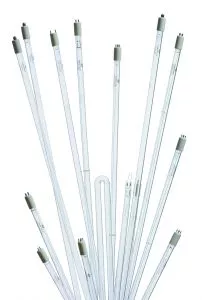
Excimer lamps are also effective at producing ozone, a natural oxidizer, odor reducer, and disinfectant effective in air and water disinfection applications. Ozone is typically produced at 172 nm standard low-pressure mercury lamps, although Excimer lamps filled with xenon are an efficient source to generate ozone with no nitrogen oxides (NOx) as the UV radiation is not high enough to excite nitrogen in the air.
Excimer lamps are proving to be a very exciting development and an increasingly promising offering in the UV lamp market.
LightSources is currently in the development of Excimer lamps, and we offer a wide selection of UVC germicidal lamps used in surface, water, and air disinfection systems worldwide. We design, engineer, and manufacture UVC germicidal lamps, UV curing lamps for surface treatment applications, as well as ozone-producing lamps.
LAMP PRODUCT DATA:
UV Germicidal Lamps
LAMP APPLICATIONS:
UV Germicidal Applications
LightSources Team
When Christian L. Sauska and his former business partners established LightSources, Inc. in 1983, they envisioned a company that would offer global OEM lamp designs and manufacturing, supported by state-of-the-art technology and exceptional service and support. This vision lives today through the dedication of approximately 1,000 employees worldwide.
Today, LightSources and its affiliated companies – LCD Lighting, Voltarc along with strategic partners LightTech, and Cerlux – are regarded as innovative, high-tech, designers, light bulb manufacturers and light bulb suppliers in the lamp manufacturing industry. Our products are used worldwide across a multitude of applications and industries. We are especially proud to have our avionic display backlighting in Transportation, National Defense, and the US Space Program.
Our team, which includes experienced professionals in the production of low-pressure tanning lamps, specialty UVC germicidal lamps, custom light bulbs, and UV lamps for other specialized applications such as air purification and ballast water treatment, is committed to engineering standard, specialty, and proprietary lamp types to meet the specific requirements of our clients. From prototype to finished product, we offer unmatched flexibility and turnaround. With our innovative solutions, clients can distinguish themselves in the marketplace with their own proprietary products and private brands.
This post is also available in: Chinese (Simplified)
 Spanish
 German
LightSources Team
Click here for more information on the types of cookies we use and how to change your cookie settings. Accept
Privacy Overview
1-800-826-9465 (North America)
+44 1576 220246 (Europe Germicidal)
+36 2754 1800 (Europe Other)
+86 21 52662921 (China)